
Rotating XROMM Image
X-ray Reconstruction of Moving Morphology (XROMM)
  • Home
  • People
  • History
  • Projects
  • Publications

Multimedia

  • Pictures
  • Movies
  • News

Pictures

Avian Bipedal Locomotion

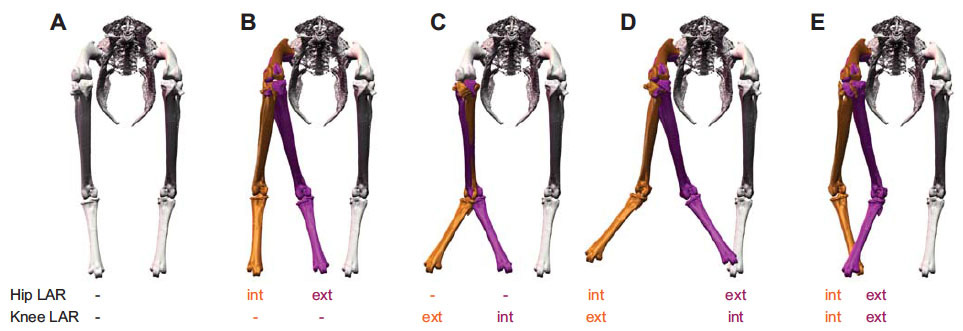
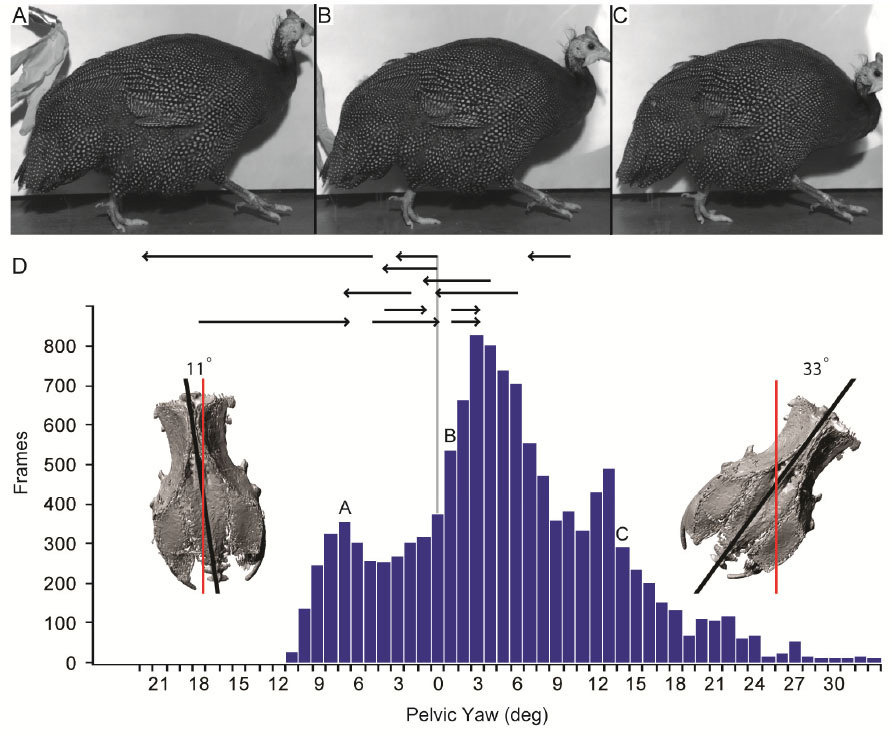
Kinematics & kinetics of long-axis rotation in avian bipedal locomotion

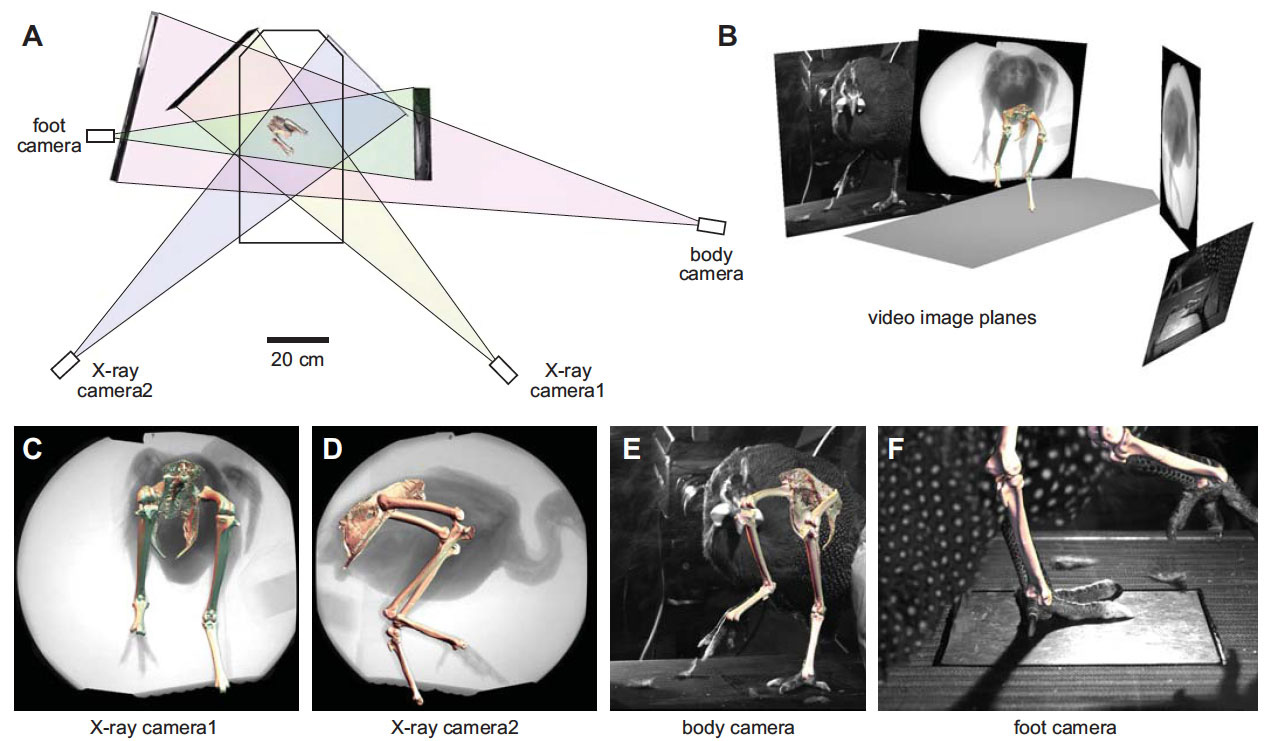
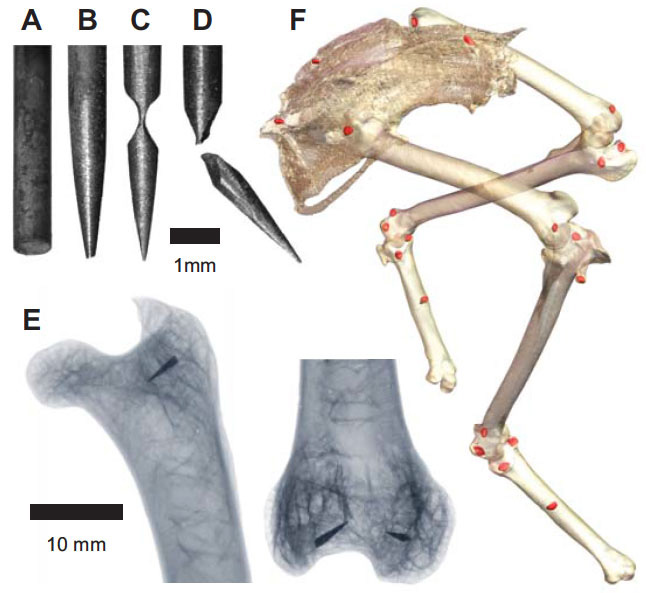
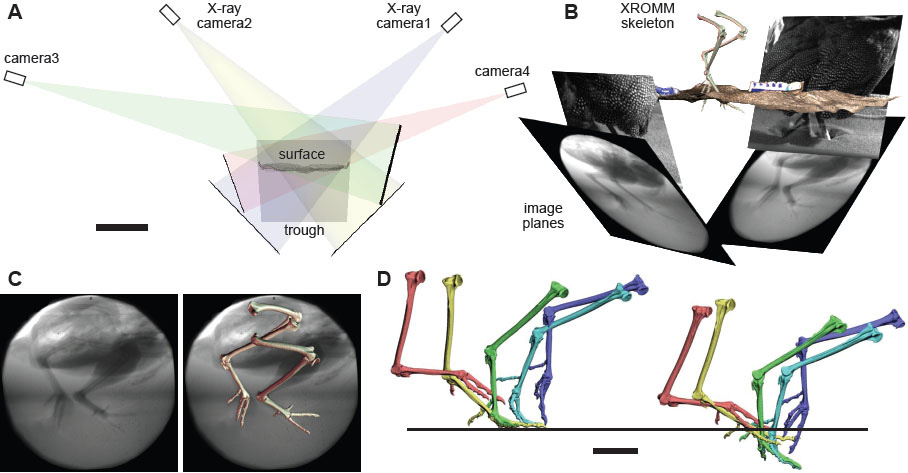
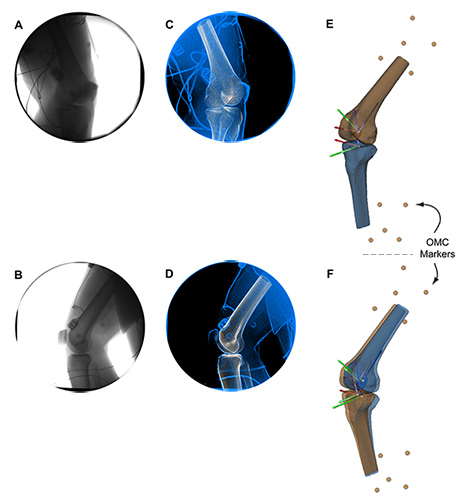
Maya reconstruction of the two x-ray beams (blue and yellow) intersecting to form a recording volume for 3-D motion analysis of guineafowl hind limbs. Bone models for the pelvis, right femur, right tibiotarsus/fibula, and right tarsometatarsus are registered using the coordinates of implanted carbide markers. Undistorted video frame from camera 1 (blue beam). Inset shows magnification of ankle region with four carbide cones. Marker coordinates represented as yellow spheres registered to undistorted video. Transparent bone (gold) and marker (red) models registered to undistorted video. Registered skeletal models as viewed from virtual x-ray focal spot.

Fish Feeding

Biomechanics of jaw protrusion in common carp
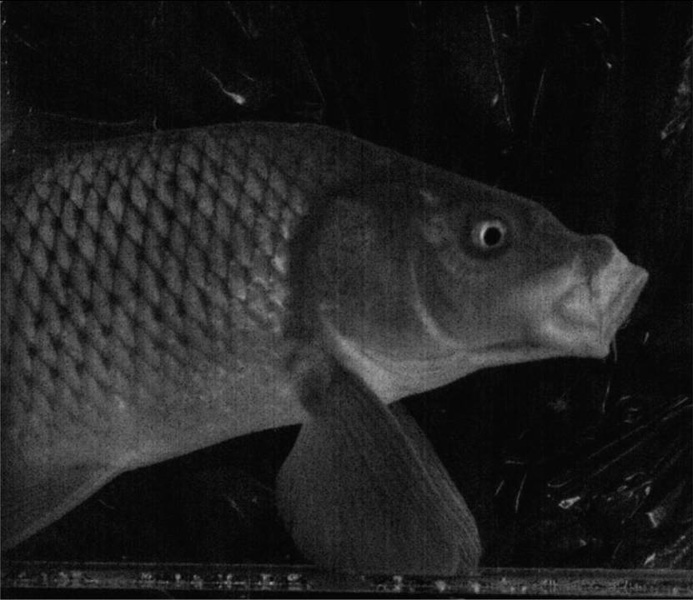
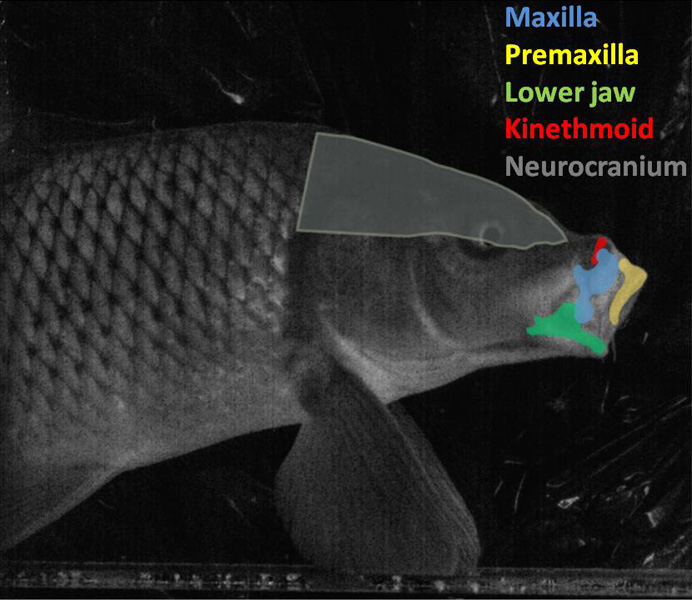
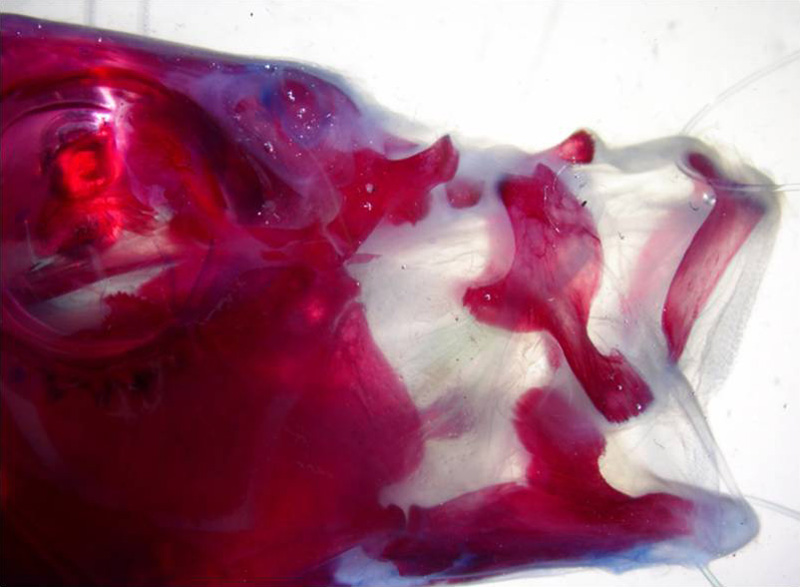
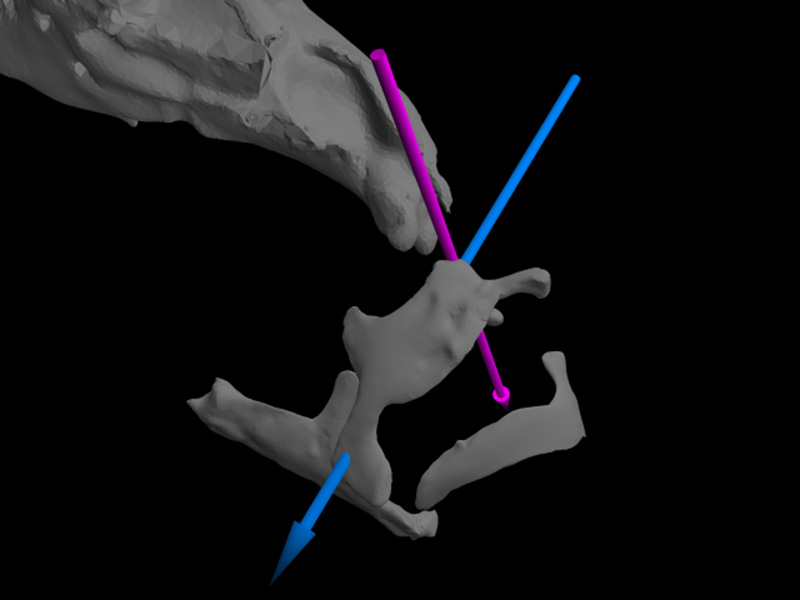
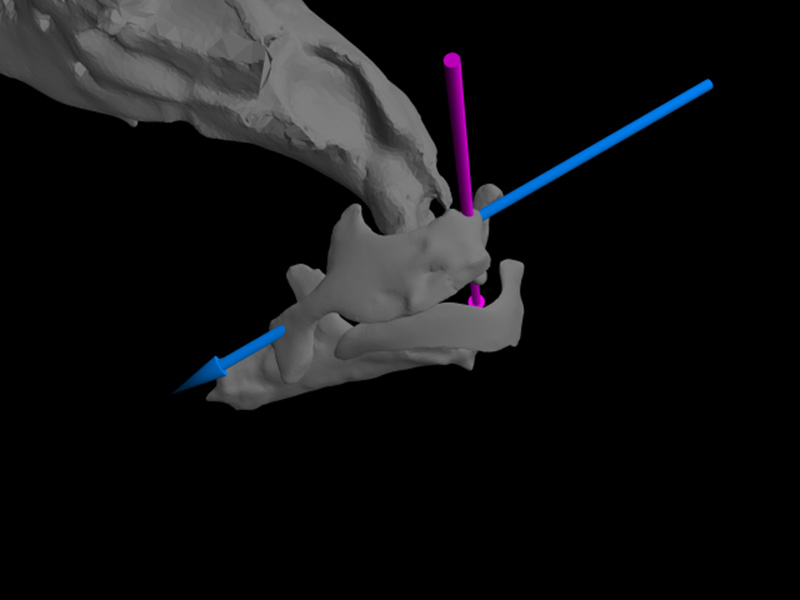
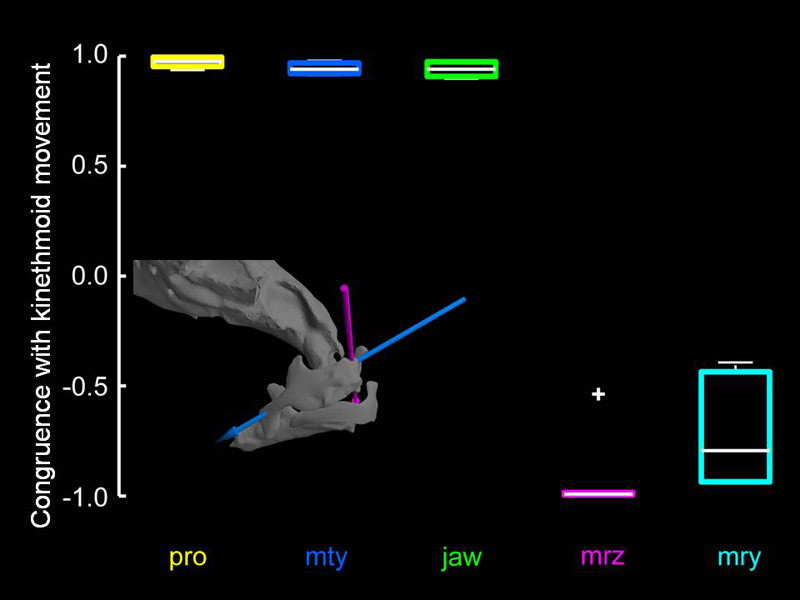
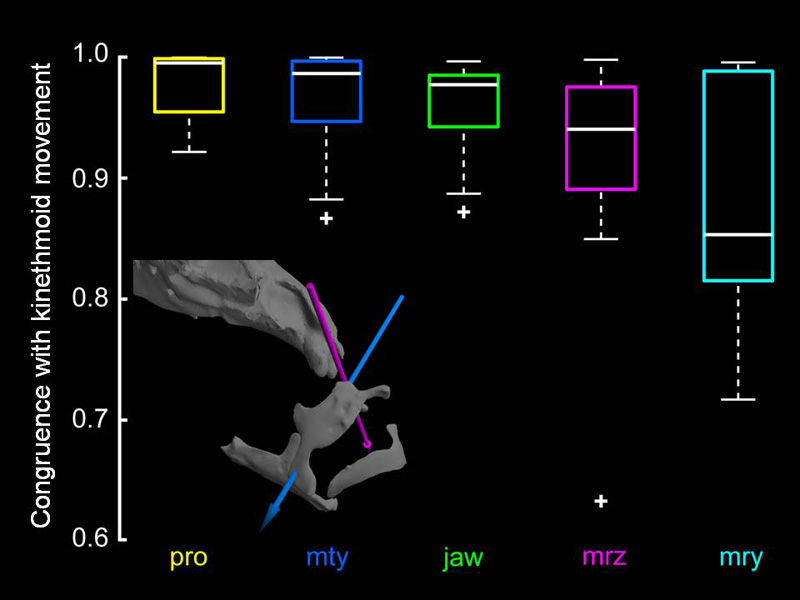
Common carp have highly kinetic skulls which allow them to protrude their upper jaws. This may aid in suction feeding performance and food-sorting within the oral cavity. In addition to typical fish skull upper jaw bones such as the maxilla and premaxilla, cypriniform fishes develop a novel bone, the kinethmoid. This mobile bone is embedded between the maxillae along the midline of the fish. Even in a stained an cleared preparation, which is specifically designed to demonstrate bone shape, a meshwork of ligaments and other bones makes the kinethmoid difficult to see in-situ. Can you find it here? This medial view of the oral jaw bones in carp demonstrates our marker placement for this study. Neurocranium markers have not been included. Once we have an xromm, we can use anatomically-relevant axis systems to describe the 6 degrees of freedom of each bone relative to other bones. Here, two of the axes of the maxilla are demonstrated for an open-mouthed protrusion.  Rotation about the magenta axis shows parasagittal rotation of the maxilla; rotation about the blue axis shows long-axis rotation of the maxilla; translation along the blue axis shows ventral translation of the maxilla. In this frame, the same axis system as Photo 5 is shown, only now the animal is performing a closed-mouth protrusion. Movement patterns of protrusion, ventral translation of the maxilla, lower jaw rotation, and parasagittal rotation of the maxilla are very highly correlated with the kinethmoid's movement pattern (y-axis values close to 1), whereas other maxillary degrees of freedom are not correlated during open mouth protrusion. During closed mouth protrusion, ventral translation is the only maxillary movement pattern that is correlated significantly with kinethmoid rotation.

Iguana Breathing

Rib kinematics & intercostal muscle strain during breathing in Iguana iguana
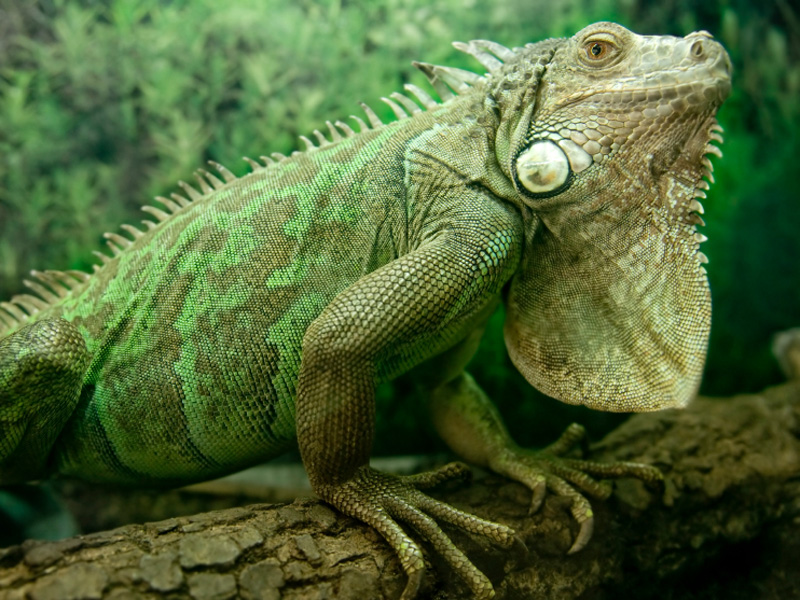
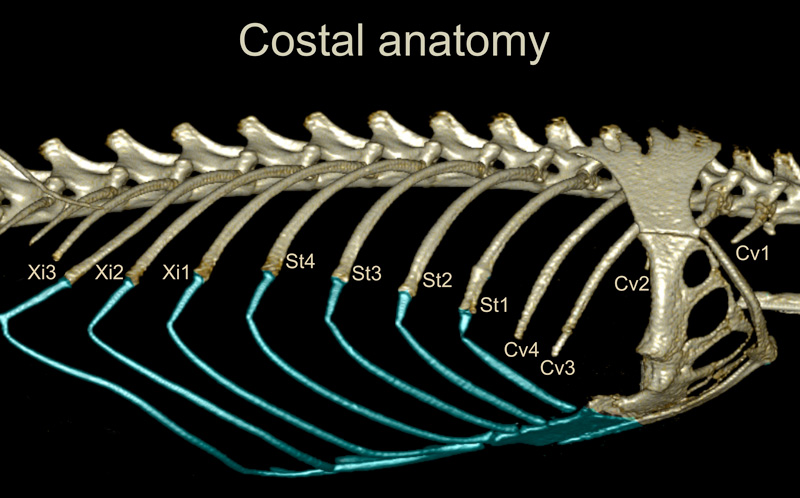
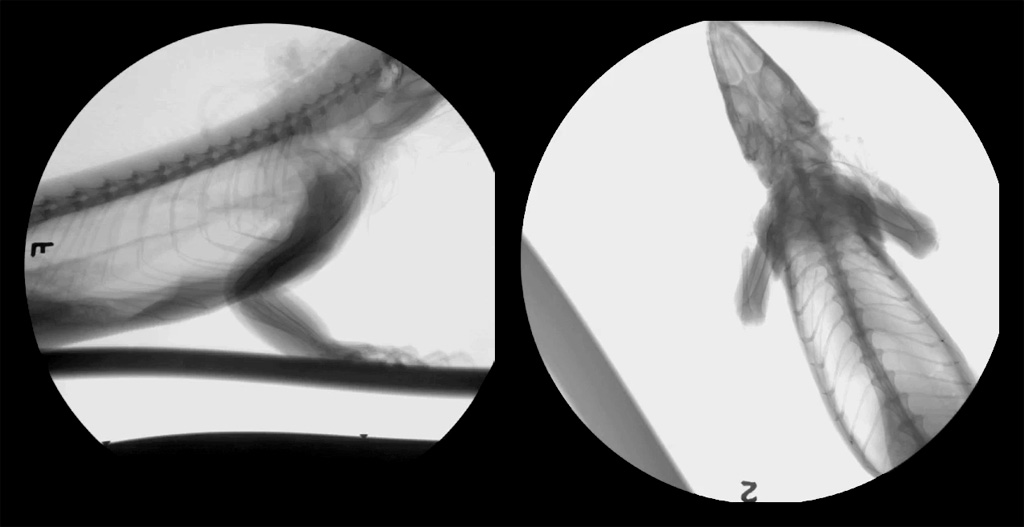
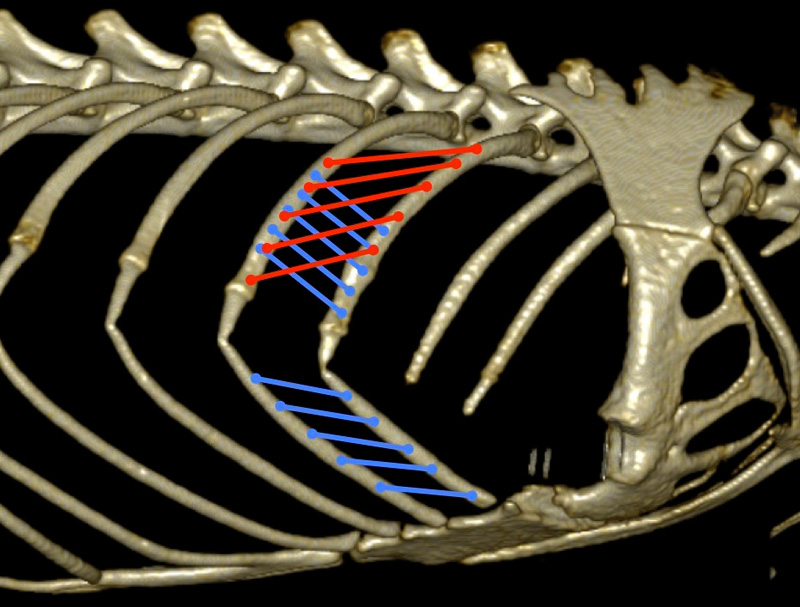
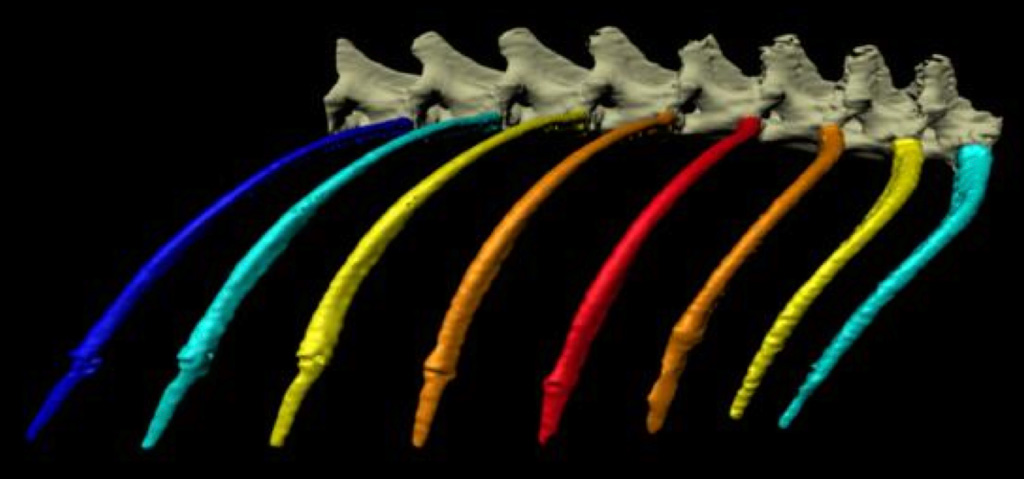
Green iguana, Iguana iguana. Green iguanas have four cervical (Cv) ribs, four sternal (St) ribs that articulate with the sternum via long costal cartilages, and three xiphisternal ribs. XROMM analysis shows that the dorsal osseous ribs (gold) and ventral costal cartilages (green) move as separate rigid elements, connected by thin cartilaginous regions that act as joints. Still image from biplanar X-ray video of lung ventilation in a green iguana. Snout-vent length of this animal is approximately 50 cm. To measure intercostal muscle fascicle strain, a 3D digitizer is used to map the fascicles from an iguana cadaver onto the 3D models of the ribs. Then the XROMM animation is used to measure intercostal fascicle strain. External intercostal (red) and internal intercostal (blue) fascicles are shown here. Rib rotation gradient with cool colors (blue) indicating less motion during breathing and hot colors (red) more motion. XROMM animations reveal little movement of Cv1 and Cv2, increasing amounts of rotation in Cv3-St1, the greatest rotation in St2, and gradually decreasing rotation in St3-4 and more caudal ribs. In the intercostal space between the osseous portions of St1 and St2, the EI lengthen during exhalation and shorten during inhalation, whereas between St3 and St4, the EI shorten during exhalation and lengthen during inhalation.

Pig Feeding

Marker-based XROMM analysis of mastication in minipigs

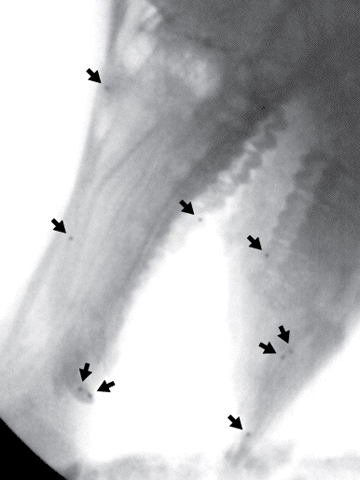
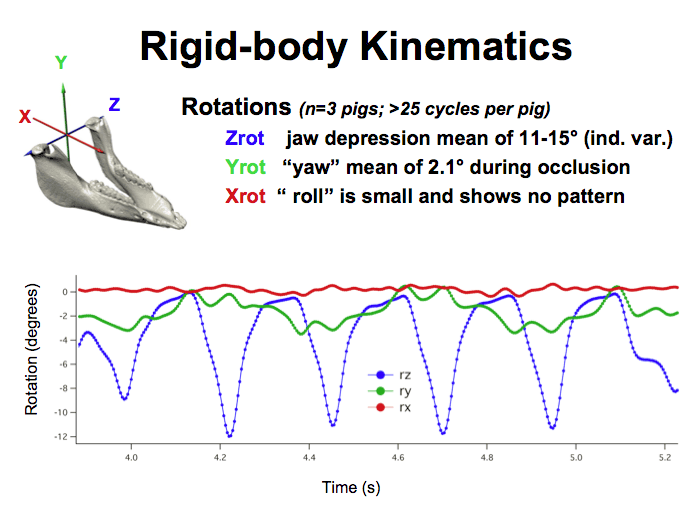
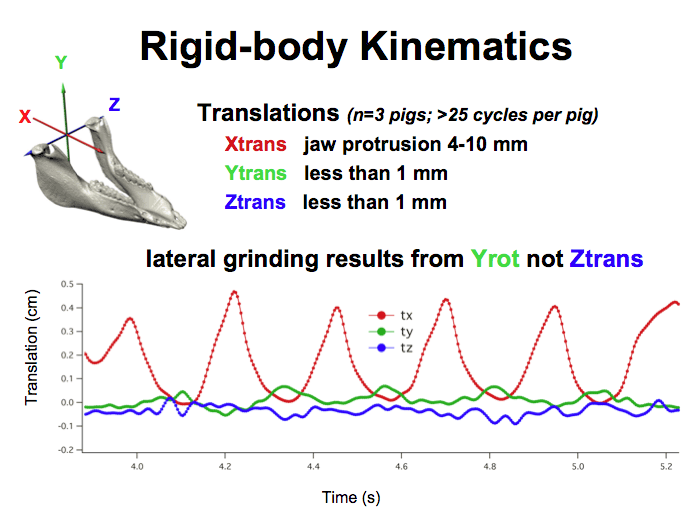
Figure 1. Sinclair strain miniature pig. Three individuals (3-4 months old) were used in this study. Figure 2. Fluoroscope image of pig snout with radiopaque tantalum markers. Bones appear dark and air white in this x-ray positive image. The tantalum beads are the small black spots. Figure 3. Lateral grinding results primarily from rotation of the mandible about a dorsoventrally oriented axis. Figure 4. Rostrocaudal translations result from jaw protrution and retrusion.

Duck Feeding

Kinematics of the quadrate bone during feeding in mallard ducks

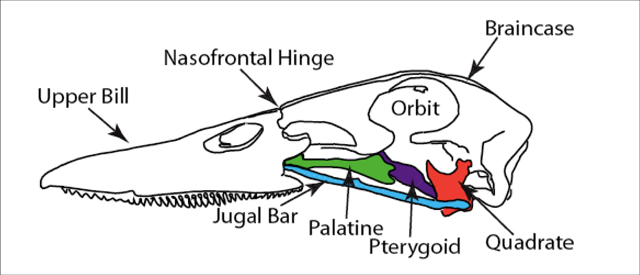
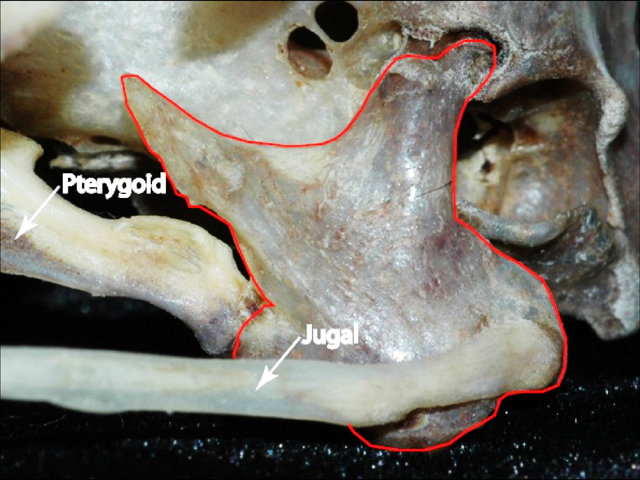
A male and female Mallard duck. All of the ducks in this study were female. Mallard duck feeding on duck chow mixed with water. The quadrate bone plays a central role in feeding mechanics, particularly in the elevation of the upper bill. It has been hypothesized that the movement of the quadrate is transferred primarily through the pterygoid and palatine bones to the upper bill (Bock 1964, Gussekloo et al. 2001, Zweers 1974, van Gennip and Berkhoudt, 1992). The quadrate articulates with four bones: pterygoid, braincase, jugal and mandible.

Hardware

Mobile C-arm fluoroscopes and biplanar x-ray rooms
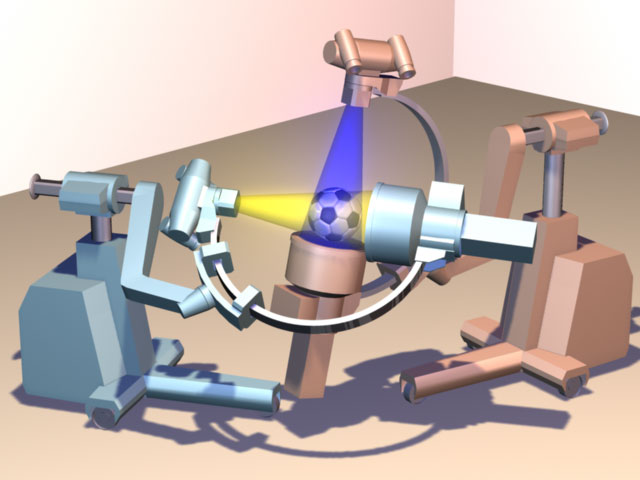
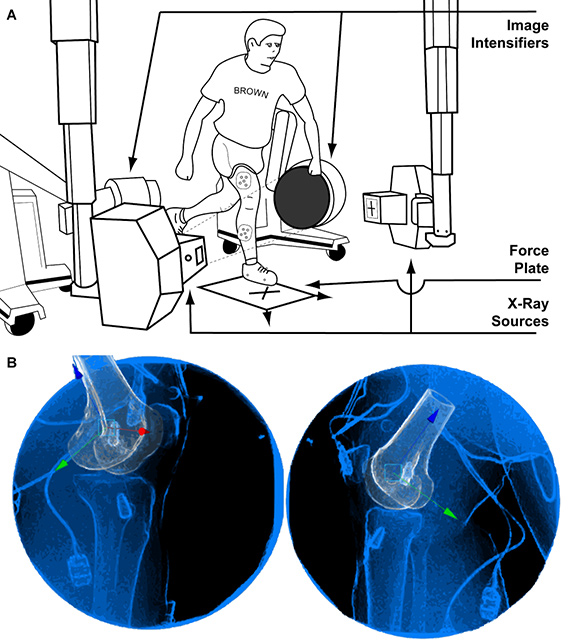
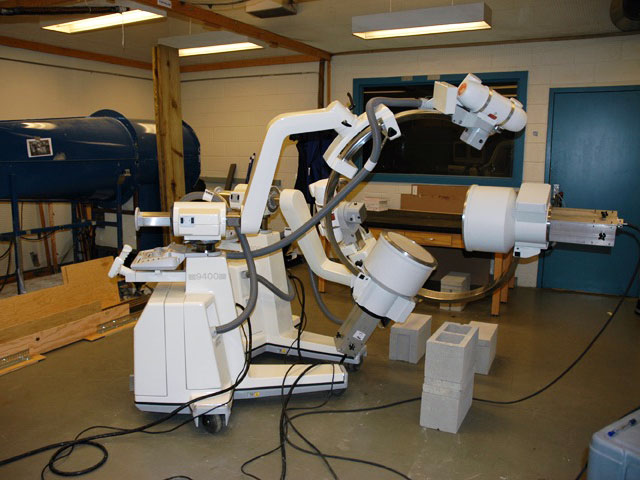
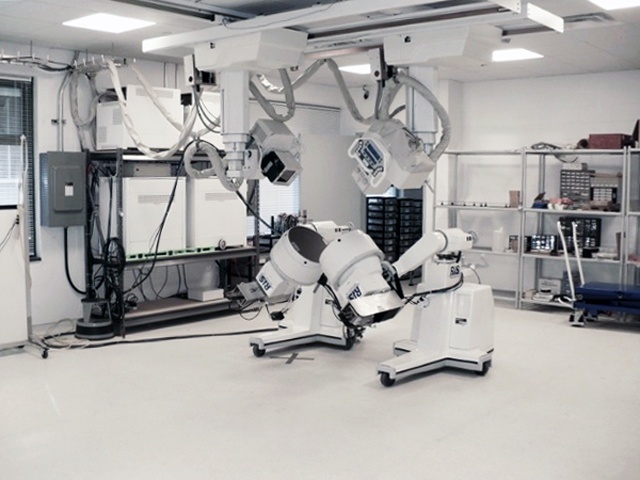
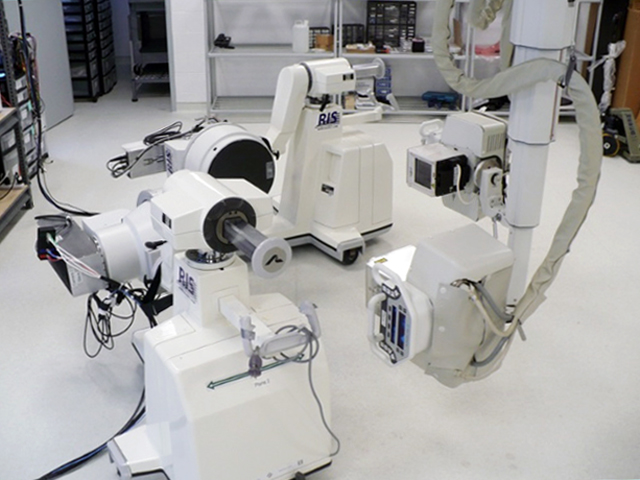
Diagram of mobile C-arm fluoroscopes, retrofitted for high-speed imaging. New 30-cm image intensifiers have been installed and the original cameras have been replaced with high-speed video cameras. A standard international (size 5) soccer ball is included for scale. Radiological Imaging Services, Hamburg PA (800-748-2040) has experience refurbishing and retrofitting C-arms for high-speed imaging. Photograph of mobile C-arm fluoroscopes, retrofitted for high-speed imaging. New 30-cm image intensifiers have been installed and the original cameras have been replaced with high-speed video cameras. Radiological Imaging Services, Hamburg PA (800-748-2040) has experience refurbishing and retrofitting C-arms for high-speed imaging. The W.M. Keck Foundation XROMM Facility at Brown University. Two x-ray tubes are suspended from the ceiling by tube cranes and two image intensifiers are mounted on mobile gantries. Independent movement of the four components gives the system a lot of flexibility in physical configuration. Here the system is configured to collect two oblique, ventro-dorsal views. The W.M. Keck Foundation XROMM Facility at Brown University. Independent movement of the four components gives the system a lot of flexibility in physical configuration. Here the system is configured to collect two oblique, medio-lateral views.

Resources

  • Software
  • Hardware
  • Scheduling
  • XROMM Wiki
  • Google Group
  • Research Coordination Network (RCN)

Site Search

Brown University

X-ray Reconstruction Of Moving Morphology • Brown University

Comments, suggestions to Elizabeth Brainerd

Web site by Tom Hoogendyk